Strength Training After 60: How Often, How Much and How to Start Safely
Most of us were taught that exercise means walking, and walking is a fine habit. But U.S. health agencies say walking alone is not the whole picture for adults 65 and older. They also recommend muscle-strengthening activity on at least 2 days each week. That sounds like a gym, but it does not have to be. It can be a stretchy band, two cans of soup, or your own body weight, done in a kitchen or living room. This guide explains in plain language what the Centers for Disease Control and Prevention (CDC) and the National Institute on Aging (NIA, part of the National Institutes of Health) actually recommend, what the words “repetition” and “set” mean, how to begin gently, and when to speak with your doctor first.
Key takeaways
- The CDC recommends that older adults do muscle-strengthening activity at least 2 days a week, in addition to about 150 minutes of moderate activity such as brisk walking and some balance work.
- One set of 8 to 12 repetitions of each exercise is effective, according to the NIA. Two or three sets may work better, but one is a good start.
- Try not to work the same muscle group on two days in a row, so your muscles can recover.
- Do not hold your breath, do not lock your joints straight, and stop if something hurts in a sharp way or you feel dizzy.
- If you have a health condition, ask your doctor which exercises are safe for you before you begin.
What “muscle-strengthening” means
Muscle-strengthening exercise is also called strength training or resistance training. The NIA describes it as activity that makes your muscles contract, often by lifting something heavy against the pull of gravity. “Resistance” simply means something that pushes back, such as a weight, a stretchy band or your own body.
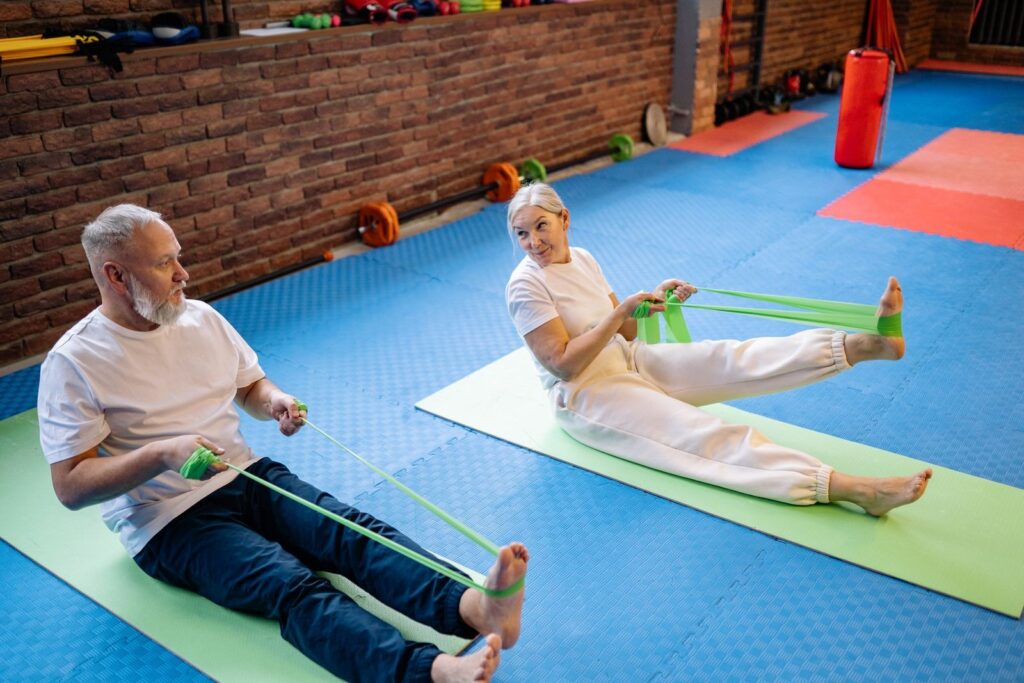
The NIA lists many ways to do it: resistance bands, weight machines and hand-held weights; exercises that lift your own body weight, such as arm circles, leg raises, push-ups, planks, squats and lunges; carrying heavy items such as groceries; and gardening that involves digging and lifting. The CDC adds that some yoga postures count too. You do not need to buy anything to begin.
Why it matters for everyday life
The NIA explains that muscle-strengthening activity improves physical function and helps you stay independent. It can make everyday jobs easier, such as getting up from a chair, climbing stairs and carrying groceries. The NIA also says this type of exercise is key to keeping the strength you already have, slowing the loss of muscle mass, and helping to prevent falls and fall-related injuries.
How often and how much
Here is the pattern the two agencies describe, put side by side.
| Question | What the guidance says |
|---|---|
| How many days a week? | At least 2 days (CDC and NIA). |
| Which muscles? | All the major groups: legs, hips, back, chest, abdomen, shoulders and arms. |
| How many repetitions? | About 8 to 12 of each exercise. That group of repetitions is one “set.” |
| How many sets? | At least one set. Two or three sets bring more benefit. |
| How hard? | Enough that it would be difficult to do another repetition without help, at a moderate level of effort or more. |
| Rest between sessions? | Avoid working the same muscle group on two days in a row. |
| Beginners? | Start with no weights or bands until the movements feel comfortable. |
A “repetition,” the CDC explains, is one complete movement, for example one full stand up from a chair and sit back down. Doing it 8 to 12 times is one set. The phrase “difficult to do another repetition” is the key to the effort level. The last few repetitions should feel like real work, but never painful.
Where it fits with your walking
The CDC’s weekly pattern for older adults has three parts. First, at least 150 minutes of moderate-intensity activity, for example 30 minutes a day on 5 days, or 75 minutes of vigorous activity, or an equal mix. Second, muscle-strengthening on at least 2 days. Third, activities that improve balance, such as standing on one foot. The NIA adds a suggestion of about three balance sessions a week, and notes that doing one type of exercise can help you do the others.
A simple week, for example, could look like this. Walk briskly on five days. On two non-consecutive days, add a short strength routine. Practise balance for a few minutes whenever you are waiting for the kettle to boil. Several activities also combine types: the NIA names dancing, yoga, tai chi, gardening and some sports as combinations.
The CDC also says that some activity is better than none. If you cannot reach the full amounts, be as active as your abilities and health allow.
How to begin, step by step
The NIA and MedlinePlus Magazine (a National Library of Medicine publication, which reprints NIA advice) suggest starting gradually. Here is one way to follow that advice.
- Talk to your doctor first if you have any concern. Ask which activities to avoid and whether any health condition might change what is safe for you. MedlinePlus Magazine says almost anyone at any age can exercise safely, but it still recommends this conversation if you are worried.
- Begin with your own body weight. A sit-to-stand from a sturdy chair works the legs and hips. A wall push-up (standing, hands on the wall) works the chest and arms. These are examples of ordinary movements, not an official program.
- Do one set of 8 to 12 repetitions. Go slowly. If you cannot reach 8 comfortably, do fewer and build up.
- Warm up. The NIA suggests warming up for strength work by doing the exercises with less weight first.
- Add a band or light weights when the movements feel comfortable. The NIA says gradual increases in weight, sets, repetitions or days per week will make muscles stronger. Change one thing at a time.
- Rest and repeat. Give each muscle group a day off before you work it again, and aim for at least 2 sessions a week.
- Drink water. MedlinePlus Magazine reminds readers to drink plenty of water before, during and after exercise. If your doctor has limited your fluids, check with them first, as the NIA notes.
Safety rules worth memorising
Breathing and joints
The NIA gives two clear rules. Do not hold your breath during strength exercises: breathe out during the effort and breathe in as you relax. And avoid “locking” your arm and leg joints in a straight position. Keep a small bend in the elbow or knee at the end of each movement.
Listen to your body
The NIA warns that overdoing muscle-strengthening exercise can cause exhaustion, sore joints, and muscle pain or injury. A little muscle tiredness is expected. Pain in a joint, chest discomfort, dizziness or trouble breathing is not, and is a reason to stop and call a professional. (The NIA lists dizziness, chest pain or pressure and nausea as warning signs for aerobic activity, and the same common sense applies here.)
Get help with form
If you are unsure about a movement, the NIA suggests asking your doctor or a physical therapist. It also suggests booking a session or two with a personal trainer, or joining a group class at a local gym, recreation center or senior center, to learn proper form. Free online videos showing strength exercises can help as well.
When walking or stairs are hard
The CDC says that if some activities are hard, such as climbing stairs or walking, you can choose other kinds, for example chair exercises. After an illness or a break from travel, the CDC advises starting again at a lower level and working back up slowly. If you have a chronic condition such as arthritis, diabetes or heart disease, the CDC says to ask your doctor whether it limits your activity, then make a plan that fits your abilities. For anyone with a disability, the CDC advises talking with a doctor before beginning a routine.
Everyday chores that count
The CDC says chores such as mowing the lawn or carrying groceries can count toward your activity. The NIA lists carrying heavy items and gardening among strength activities. Think of them as a bonus rather than a replacement. A planned routine lets you work all the major muscle groups on purpose, which chores seldom do.
A simple checklist for your first week
- Check with my doctor if I have a health condition or any concern.
- Choose two days that are not back to back, for example Tuesday and Friday.
- Pick a sturdy chair and a clear patch of floor or wall.
- Do one set of 8 to 12 repetitions of each exercise I choose, working legs, hips, back, chest, abdomen, shoulders and arms over time.
- Breathe out on the effort, breathe in on the release.
- Keep my joints slightly bent, never locked.
- Stop for sharp pain, dizziness or chest discomfort.
- Drink water, and write the date in a notebook so I can see progress.
Frequently asked questions
Is it too late to start strength training at 70 or 80?
The NIA and CDC recommendations are written for older adults in general, and MedlinePlus Magazine says almost anyone at any age can exercise safely. Individual health differs, so ask your own doctor how to begin.
Do I need weights or a gym?
No. The NIA says beginners can try exercises without weights or bands until they are comfortable, and lists body-weight exercises, bands and carrying groceries as examples. The CDC lists body-weight exercises and gardening as well.
Can I do strength exercises every day?
The NIA advises avoiding the same muscle group on two days in a row. You could, for example, work your legs on one day and your arms the next, but 2 days a week of whole-body work is the target the agencies state.
How will I know it is hard enough?
The CDC and NIA both say to work until it would be difficult to do another repetition. If you finish a set and could easily do many more, a little more weight, a stronger band or an extra set may be appropriate, increased gradually.
Before you decide
Strength training is one of three kinds of activity that the NIA says older adults need, alongside aerobic activity and balance work. You do not have to do it perfectly. Two short sessions a week, done carefully, match what federal guidance recommends. Start small, keep a note of what you do, and talk with your doctor or a physical therapist about anything that worries you. The goal is simply to keep doing the things that matter to you, such as standing up easily, climbing the stairs and carrying your shopping home.
Sources
- Three Types of Exercise Can Improve Your Health and Physical Ability (National Institute on Aging, NIH; content reviewed January 14, 2025)
- Older Adult Activity: An Overview (Centers for Disease Control and Prevention)
- Older Adults: Adding Activity Recommendations (Centers for Disease Control and Prevention)
- What Counts as Physical Activity for Adults (Centers for Disease Control and Prevention)
- 4 physical activity tips for older adults (MedlinePlus Magazine, National Library of Medicine)
Last updated: November 2026. This article is general information, not medical advice; talk to your doctor or physical therapist before starting any exercise program.