Give Leftovers a Date and a Destination
A container of leftovers is easier to use well when it has two things written on it: the day you cooked it, and the meal you plan to eat it at. That small habit helps with the most important food-safety rules, which are chilling cooked food quickly, eating it within a few days, and freezing what you will not eat in time. This guide shows how, using advice from the United States Department of Agriculture (USDA), the Food and Drug Administration (FDA) and the Centers for Disease Control and Prevention (CDC). The numbers below were checked on their pages in November 2026.
Key takeaways
- Put cooked food in the refrigerator within 2 hours, or within 1 hour if the air is hotter than 90°F.
- Refrigerated leftovers are kept for 3 to 4 days. Freeze anything you will not eat by then.
- Write three things on the container: what it is, the day it was cooked, and the meal it is for.
- Reheat leftovers until a food thermometer reads 165°F.
- Adults aged 65 and older are listed as being at higher risk of food poisoning, so it pays to be careful with the clock.
Why leftovers need a clock
Food poisoning often comes from germs, called bacteria, that grow in food. The USDA says they grow rapidly at temperatures between 40°F and 140°F, a range it calls the “danger zone.” Hot food should be kept at 140°F or above, and cold food at 40°F or below.
For this reason the USDA says leftovers must go into the refrigerator within 2 hours of cooking, or within 2 hours of coming off a warming dish. If the air is above 90°F, as at a summer picnic, the limit is 1 hour. Perishable food left out longer should be thrown away. The FDA applies the same two-hour rule to restaurant doggie bags and take-out food.
A leftover can be unsafe even when it looks, smells and tastes fine. The FDA explains that the bacteria that make people ill are different from the ones that make food go off. So the date on the container is more reliable than your nose.
Cool it quickly and wrap it well
A big pot of hot soup takes a long time to cool in the middle, which gives bacteria time to grow. The USDA and CDC both advise dividing large amounts of food into shallow containers so they cool faster. Roasts, hams and turkey should be sliced or cut into smaller pieces first.
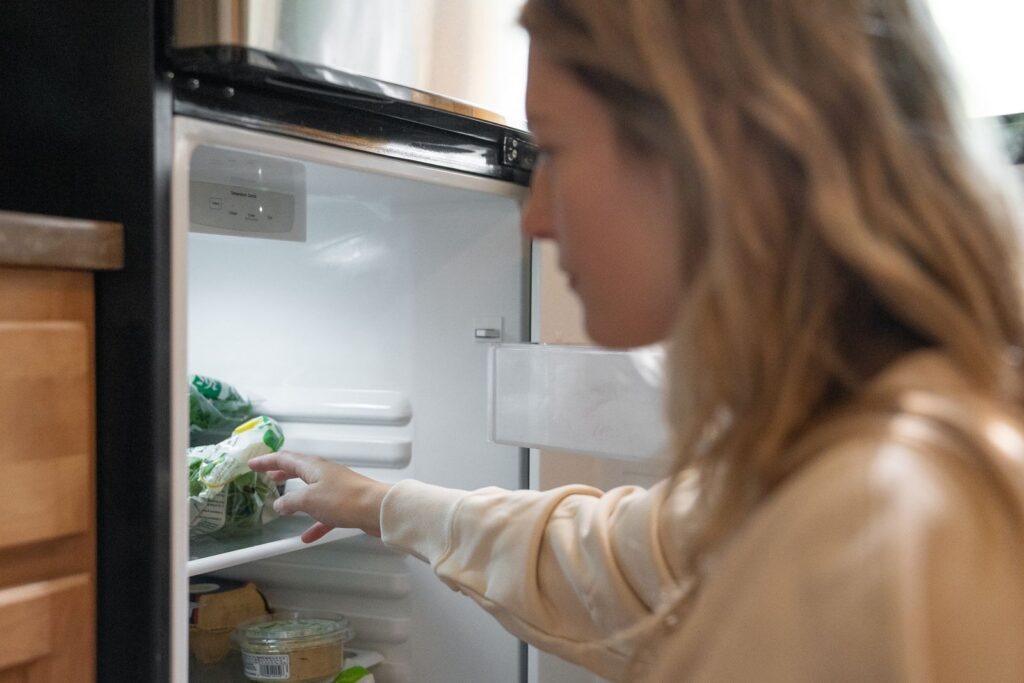
You do not need to wait for food to cool on the counter. The USDA says hot food can go straight into the refrigerator, or you can chill it first in a bowl of ice or cold water. Then cover it, wrap it airtight, or seal it in a container. That keeps germs out, holds in moisture and stops the food from picking up other smells.
Check your refrigerator’s temperature
The FDA says the refrigerator should be at 40°F or below and the freezer at 0°F, and that an appliance thermometer, a small and generally inexpensive device, is the best way to know. It suggests one in each, placed at the front where you can read it, and checking at least once a week. It also says not to pack either so tightly that air cannot move around.
The label: what, when and which meal
Our suggested label has three parts. First, what the food is. Second, the day you cooked it. Third, its destination, meaning the meal you plan to eat it at. For example: “Bean stew, cooked Saturday, Monday lunch.”
The USDA says leftovers can be kept in the refrigerator for 3 to 4 days. On a page about people at higher risk, FoodSafety.gov says to use cooked leftovers within 4 days. The agencies do not explain how to count the first day. A cautious way is to count the day you cooked as day one. On that count, stew cooked Saturday and eaten Monday lunch is at day three, which is inside the window.
If the destination falls outside the window, freeze the food now rather than hoping. Cooked on Tuesday, wanted on Sunday? Write “freezer” on the label and put it there that evening. The table shows the times FoodSafety.gov lists for common leftovers. Its freezer times are about quality only. Food kept at 0°F stays safe indefinitely, but it can dry out and lose flavor.
| Leftover | Refrigerator (40°F or below) | Freezer (0°F or below), for quality |
|---|---|---|
| Cooked meat or poultry | 3 to 4 days | 2 to 6 months |
| Soups and stews with vegetables or meat | 3 to 4 days | 2 to 3 months |
| Pizza | 3 to 4 days | 1 to 2 months |
| Casseroles with eggs, after baking | 3 to 4 days | 2 to 3 months |
| Egg, chicken, ham, tuna or macaroni salad | 3 to 4 days | Does not freeze well |
Reheating and freezing safely
Reheating
The USDA says to reheat leftovers until a food thermometer reads 165°F. Bring sauces, soups and gravies to a rolling boil, which means large bubbles breaking across the whole surface. Cover the food as it heats, because that keeps it moist and helps it heat all the way through.
In a microwave, cover the dish, leave a vent for steam, and turn the food partway through. Microwaves leave cold spots, so the USDA says to check the temperature in several places and let the food rest before the final reading.
Thawing and refreezing
The USDA lists three safe ways to thaw leftovers: in the refrigerator, in cold water, or in the microwave. The CDC adds that food should never be thawed on the counter. After thawing in the refrigerator, use the food within 3 to 4 days or refreeze it. You may also reheat frozen soup or a casserole without thawing it, though it takes longer.
Food thawed in cold water must be cooked before it is refrozen. Food thawed in the microwave should be heated to 165°F first. If you reheat previously frozen leftovers to 165°F, any that remain can be refrozen.
Planning portions around your week
Picture a household with two extra portions after dinner. One person has a refrigerator at work tomorrow. The other will be out all day. Their plans need not match. Ask where the food can stay cold, whether it will really be eaten, and which portion belongs in the freezer.
Keep the destination realistic. If you already have lunches arranged, do not label every leftover for lunch. Ask which meal this portion replaces. If portions are often left behind, cook a little less next time.
- Set out containers before cooking, so putting food away is part of finishing the meal.
- Divide hot food into shallow containers and chill it within 2 hours.
- Label each container with the food, the day cooked and the planned meal.
- Choose one: eat within 3 to 4 days, or freeze that evening.
- Check that the refrigerator thermometer reads 40°F or below.
- Reheat to 165°F and check with a food thermometer.
Extra care at 65 and older
FoodSafety.gov lists adults aged 65 and older among the groups more likely to get food poisoning or become seriously ill. Others are children under 5, pregnant women and people with weakened immune systems. Its advice for these groups is the same four basic steps, which include chilling cooked leftovers within 2 hours, plus extra tips on safer food choices.
The FDA says that anything that looks or smells suspicious should be thrown out, and that food which was not refrigerated properly is usually best thrown out too. This article cannot tell you how these rules apply to your own health. If you have a condition or take medicines that affect what you can eat, ask your doctor or a registered dietitian.
Frequently asked questions
Do I need to let hot food cool on the counter before I put it away?
No. The USDA says hot food can go straight into the refrigerator, and shallow containers help it cool faster. Do not let it sit out for more than 2 hours, or 1 hour in hot weather.
Can I tell by smell whether a leftover is still safe?
Not reliably. The FDA says food can make you very sick even when it does not look, smell or taste spoiled. Use the date and the storage times, and throw out food you are unsure about.
Does freezing make leftovers safe forever?
Food stored continuously at 0°F stays safe indefinitely, according to FoodSafety.gov and the FDA. Over time its quality falls, so the freezer times in the table are about flavor and texture.
Can I refreeze leftovers I have thawed?
It depends on how they were thawed. After refrigerator thawing, they can be refrozen. After cold-water thawing, cook them first. After microwave thawing, heat them to 165°F first.
Before you decide
A date and a destination turn a vague tub of food into a decision you make once, at the end of the meal. Each leftover gets a clear next step: eat it within 3 to 4 days, or freeze it that evening. If a leftover has no plan, or you cannot remember when it was cooked, that is the moment to be careful and throw it out. For a food that is not in the table, check the USDA and FoodSafety.gov sites.
Sources
- Leftovers and Food Safety (Food Safety and Inspection Service, U.S. Department of Agriculture; page last updated July 31, 2020)
- Cold Food Storage Chart (FoodSafety.gov; reviewed September 19, 2023)
- People at Risk of Food Poisoning (FoodSafety.gov; reviewed August 14, 2025)
- Are You Storing Food Safely? (U.S. Food and Drug Administration; content current as of January 18, 2023)
- Preventing Food Poisoning (Centers for Disease Control and Prevention; November 24, 2025)
Last updated: November 2026. This article is general information, not medical or food-safety advice.