A Step Count Does Not Tell You How Hard Your Walk Felt

Two walks can add about the same number to a step counter and still feel completely different. One is a relaxed trip through the shops. The other includes a hill that changes your breathing. A step counter tells you how many steps you took. It cannot tell you how hard the walk felt. This guide explains how the CDC describes effort, what research says about step totals, and how a few notes can give you a fuller picture. It is general information, not a personal exercise plan.
Key takeaways
- For adults 65 and older, the CDC states weekly activity goals in minutes of moderate or vigorous effort, not in steps.
- The CDC defines effort by how hard an activity feels to you. Its “talk test” says that during moderate activity you can talk but not sing.
- A 2025 review of 57 studies linked about 7,000 steps a day to a 47 percent lower risk of early death than 2,000 steps, with smaller extra gains beyond that.
- Steps-per-minute rules of thumb vary. About 100 a minute is often cited for adults, but one 2023 study of adults aged 60 and older estimated about 70.
- Notes on time, route and effort tell you more than one daily number, and they help a clinician understand your routine.
What a step counter can and cannot tell you
A step counter, whether a watch, a phone or a small clip-on device, adds up your steps. That is useful, because a rising count can show that you are moving more. But the count treats every step alike. A slow stroll with a shopping bag, a brisk walk on flat ground and a climb up a slope can produce similar totals.
That is why the CDC does not describe its goals in steps. For adults 65 and older, it asks for at least 150 minutes a week of moderate-intensity activity, or 75 minutes of vigorous activity, or an equivalent mix, plus muscle-strengthening on at least 2 days a week and balance activities. Intensity means how much effort an activity takes, and moderate and vigorous are two levels of effort. To follow these goals, you need some way to judge effort, and a step total does not give you one.
How hard did it feel? The CDC’s two simple tools
The CDC uses the idea of relative intensity, which means effort measured against your own fitness. The same walk can feel easy to one person and hard to another, and both are correct. The CDC offers two ways to judge it. The first is a 0 to 10 scale, where 0 is sitting and 10 is maximal effort. The second is the talk test, which asks whether you can speak comfortably while you move. The table puts them side by side.
| Rating on the 0 to 10 scale | Effort level | What the talk test feels like |
|---|---|---|
| 0 | Sitting | Not applicable |
| 5 or 6 | Moderate | You can talk, but you could not sing |
| 7 or 8 and above | Vigorous | You can say only a few words before you need to pause for breath |
| 10 | Maximal effort | Not applicable |
The CDC gives brisk walking, at 2.5 miles an hour or faster, as an example of moderate activity. Jogging and running are examples of vigorous activity.
These tools estimate effort. They are not a medical clearance, and they are not a reason to push through discomfort. If a breathing or speech condition makes the talk test unreliable for you, ask your clinician for a suitable way to judge effort.
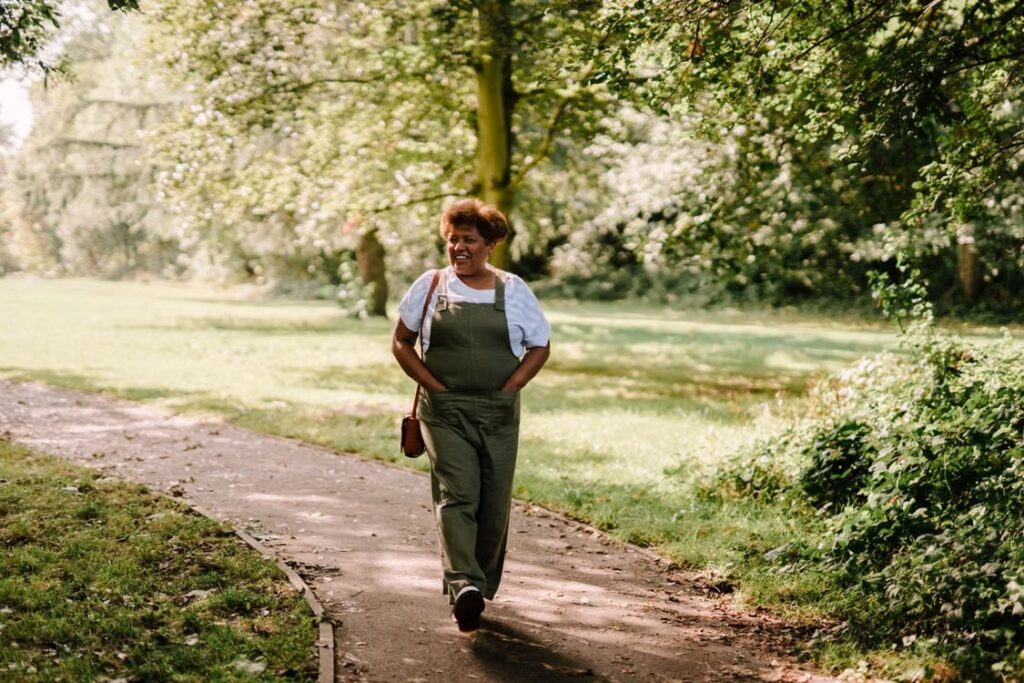
Here is an illustration, not a real case. Walk A is a flat, easy stroll through the shops, and talking is no problem. Walk B is a similar length but includes a long hill, and by the top you can speak only in short phrases. A step counter might record similar totals, but the effort would be quite different.
What research says about step totals
None of this means step counts are useless. A University of Sydney announcement dated July 24, 2025 describes a review of 57 studies published in The Lancet Public Health. It says 7,000 steps a day was linked with a 47 percent lower risk of early death than 2,000 steps, nearly as much as the benefit seen at 10,000 steps. The same review linked 7,000 steps to a 38 percent lower dementia risk, with only a further 7 percent reduction at 10,000 steps.
The announcement also says moving from 2,000 to 4,000 steps a day is linked with meaningful gains, and that beyond 7,000 steps the extra benefit for most outcomes is modest. Its lead researcher called 7,000 a realistic goal.
Please keep two limits in mind:
- The review combines studies of groups of people and reports links. These are group averages, not a promise for any one person.
- The page does not report results by age group, and it does not discuss how fast or how hard people walked. A step total says how much you moved, not how it felt.
The CDC’s goals are about minutes of effort, and the step research is about total daily movement. You can use both.
Why one steps-per-minute rule does not fit everyone
You may have heard that a certain number of steps per minute equals moderate effort. Researchers call this walking cadence. They often compare such rules using a unit called a MET, short for metabolic equivalent. One MET is the energy you use while sitting quietly, and the CDC calls activities between 3 and 5.9 METs moderate.
A 2017 systematic review in the Journal of Sports Medicine examined 31 studies. It found that about 100 steps a minute is generally linked with moderate effort in adults, roughly 3 METs. The authors added cautions. Older adults may need a higher cadence to reach the same effort, height, leg length and body weight all matter, and people often walk more slowly in everyday life than in a test. A single number may not fit everyone.
A 2023 study in the International Journal of Behavioral Nutrition and Physical Activity looked at 53 adults aged 60 or older, with a median age of 75. It estimated that about 70 steps a minute matched moderate effort, well below 100, though cadence still varied from person to person. The authors noted that the sample was small and called for more research.
The two studies used different people and methods, so their numbers differ. This is a good reason to rely on how the walk feels to you, and to treat any steps-per-minute figure as a rough guide.
Keep a simple walk log
A few notes after a usual walk give context that a daily total leaves out. Weather, carrying bags, stopping often and hills can all change the experience. The example row shows one way to record it.
| Date | Minutes | Route | Effort (0 to 10) | Talk test | Notes |
|---|---|---|---|---|---|
| Example: Tuesday | 10 | Flat, then an uphill return | 4 outward, 6 returning | Easy out, short phrases on the hill | Windy, carrying a bag |
After each walk, you can use this checklist:
- Note roughly how long you walked and whether the route was flat or hilly.
- Give the effort a number from 0 to 10, and note how the talk test felt.
- Write down anything that changed the walk, such as weather, bags or stops.
- Write down any symptoms you noticed, to share with your care team.
This is a record of your routine, not a fitness score.
Walking with others, and talking with your care team
If you walk with someone, agree on the route and pace before you set off, and agree that either person can ask to slow down or stop. A comfortable social walk is worthwhile even if it is gentler than the one you imagined. Choose a place where you can hear each other and watch the crossings.
If you are unsure what level of activity is right, describe your regular route, effort and any symptoms to your care team. That gives them more to work with than a number on a watch. HHS’s MyHealthfinder page for older adults says to tell your doctor about shortness of breath, chest pain or unplanned weight loss, and to ask whether any medicine you take could affect how your body responds to exercise. Follow any limits your clinician has already given you.
Frequently asked questions
Do I need to reach 10,000 steps a day?
The review above linked 7,000 steps to nearly the same benefit as 10,000, but these are group findings, not personal targets. Ask your clinician what is right for you.
Does a slow walk still count?
The CDC says some physical activity is better than none. The CDC’s weekly goals, however, are written for moderate or vigorous effort.
What if the talk test does not work for me?
Ask your clinician about a suitable way to judge effort given your breathing or speech. The 0 to 10 scale does not depend on talking, so it may help.
Do I need a fitness watch to judge effort?
No. The two CDC tools described here, the 0 to 10 scale and the talk test, need no device.
Before you decide
Keep your step counter if it helps you notice movement, and add the missing parts: time, route and effort. Try the talk test on your next usual walk, write down what you notice, and bring the notes to your next appointment.
Sources
- How to Measure Physical Activity Intensity | Physical Activity Basics | CDC – Centers for Disease Control and Prevention (page dated December 4, 2025)
- Older Adult Activity: An Overview – Centers for Disease Control and Prevention (page dated December 4, 2025)
- Rethink the 10,000 a day step goal, study suggests – The University of Sydney (July 24, 2025)
- Walking Cadence to Exercise at Moderate Intensity for Adults: A Systematic Review – Journal of Sports Medicine, 2017 (via PubMed Central)
- Moderate-intensity stepping in older adults: insights from treadmill walking and daily living – International Journal of Behavioral Nutrition and Physical Activity, 2023 (via PubMed Central)
- Stay Active as You Get Older: Quick Tips – MyHealthfinder, Office of Disease Prevention and Health Promotion (content updated October 2, 2026)
Last updated: November 2026. This article is general information, not medical advice.